Blog

  • CRITICAL SECURITY BREACH NOTIFICATION

    CRITICAL SECURITY BREACH NOTIFICATION

    CRITICAL SECURITY BREACH NOTIFICATION

    EFFECTIVE DATE: November 10, 2025

    NOTICE OF UNAUTHORIZED ACCESS AND DISCLAIMER OF LIABILITY

    This website was subject to unauthorized access and control by unknown third parties for approximately sixteen (16) months, from June 26, 2024 – November 2025.

    BREACH DETAILS:

    During the aforementioned period, the legitimate owner and operator of this website had NO access, control, or knowledge of activities conducted through this domain.

    POTENTIAL MISUSE:

    This website may have been used without authorization for purposes including but not limited to:

    • Sending fraudulent or malicious emails

    • Processing unauthorized transactions or payments

    • Collecting, storing, or distributing user data

    • Hosting illegal, harmful, or offensive content

    • Distributing malware or viruses

    • Conducting phishing or social engineering attacks

    • Engaging in hate speech or discriminatory content

    • Facilitating terroristic activities or communications

    • Any other unlawful or harmful activities

    DISCLAIMER OF LIABILITY:

    The legitimate owner of this website explicitly DISCLAIMS ALL LIABILITY and responsibility for:

    1. Any and all content published on this website during the breach period

    2. Any emails sent from this domain during the breach period

    3. Any financial transactions processed through this website during the breach period

    4. Any data breaches, theft, or misuse of user information

    5. Any harm, damages, or losses suffered by visitors or users

    6. Any illegal activities conducted through this platform

    7. Any malicious software distributed via this website

    OFFICIAL RECORD:

    This notice serves as an official record and legal documentation that this website was compromised and operated by unauthorized parties during the stated period. The legitimate owner had no knowledge of, participation in, or control over any activities conducted during this time.

    ACTION FOR AFFECTED USERS:

    If you interacted with this website between June 26, 2024 – November 2025:-

    → Do NOT trust any communications received from this domain

    → Do NOT honor any payment requests or transactions

    → IMMEDIATELY change any passwords or credentials used on this site

    → MONITOR your financial accounts for suspicious activity

    → REPORT any fraudulent activity to law enforcement

    → SCAN your devices for malware if you downloaded any files

    CURRENT STATUS:

    As of today,all systems are being rebuilt and secured with enhanced security measures.

    CONTACT FOR VERIFICATION:

    For verification of this notice or to report issues related to the breach, please contact:

    islamicadhkar@gmail.com

    This notice will remain prominently displayed as a permanent record of this security incident.

    Last Updated: November 10, 2025

    Document Reference Number: [BREACH-NOTICE-10112025]

  • CRITICAL SECURITY BREACH NOTIFICATION

    CRITICAL SECURITY BREACH NOTIFICATION

    CRITICAL SECURITY BREACH NOTIFICATION

    EFFECTIVE DATE: November 10, 2025

    NOTICE OF UNAUTHORIZED ACCESS AND DISCLAIMER OF LIABILITY

    This website was subject to unauthorized access and control by unknown third parties for approximately sixteen (16) months, from June 26, 2024 – November 2025.

    BREACH DETAILS:

    During the aforementioned period, the legitimate owner and operator of this website had NO access, control, or knowledge of activities conducted through this domain.

    POTENTIAL MISUSE:

    This website may have been used without authorization for purposes including but not limited to:

    • Sending fraudulent or malicious emails

    • Processing unauthorized transactions or payments

    • Collecting, storing, or distributing user data

    • Hosting illegal, harmful, or offensive content

    • Distributing malware or viruses

    • Conducting phishing or social engineering attacks

    • Engaging in hate speech or discriminatory content

    • Facilitating terroristic activities or communications

    • Any other unlawful or harmful activities

    DISCLAIMER OF LIABILITY:

    The legitimate owner of this website explicitly DISCLAIMS ALL LIABILITY and responsibility for:

    1. Any and all content published on this website during the breach period

    2. Any emails sent from this domain during the breach period

    3. Any financial transactions processed through this website during the breach period

    4. Any data breaches, theft, or misuse of user information

    5. Any harm, damages, or losses suffered by visitors or users

    6. Any illegal activities conducted through this platform

    7. Any malicious software distributed via this website

    OFFICIAL RECORD:

    This notice serves as an official record and legal documentation that this website was compromised and operated by unauthorized parties during the stated period. The legitimate owner had no knowledge of, participation in, or control over any activities conducted during this time.

    ACTION FOR AFFECTED USERS:

    If you interacted with this website between June 26, 2024 – November 2025:-

    → Do NOT trust any communications received from this domain

    → Do NOT honor any payment requests or transactions

    → IMMEDIATELY change any passwords or credentials used on this site

    → MONITOR your financial accounts for suspicious activity

    → REPORT any fraudulent activity to law enforcement

    → SCAN your devices for malware if you downloaded any files

    CURRENT STATUS:

    As of today,all systems are being rebuilt and secured with enhanced security measures.

    CONTACT FOR VERIFICATION:

    For verification of this notice or to report issues related to the breach, please contact:

    islamicadhkar@gmail.com

    This notice will remain prominently displayed as a permanent record of this security incident.

    Last Updated: November 10, 2025

    Document Reference Number: [BREACH-NOTICE-10112025]

  • The Terror of the Day of Judgement

    The Terror of the Day of Judgement

    The Day the shin will be uncovered and they are invited to prostration but the disbelievers will not be able. Their eyes humbled, humiliation will cover them. And they used to be invited to prostration while they were sound. (Surah Al- Qalam, verses 42-43)

    After Allah mentions that those who have Taqwa, will have Gardens of Delight with their Lord, He explains when this will be, and its actual occurrence. He says,

    (The Day when the Shin shall be laid bare and they shall be called to prostrate themselves, but they shall not be able to do so.) meaning, the Day of Judgment and the horrors, earthquakes, trials, tests and great matters that will occur during it. Al-Bukhari recorded that Abu Sa`id Al-Khudri said that he heard the Prophet saying,

    (Our Lord will reveal His Shin, and every believing male and female will prostrate to Him. The only people who will remain standing are those who prostrated in the worldly life only to be seen and heard (showing off). This type of person will try to prostrate at that time, but his back will made to be one stiff plate (the bone will not bend or flex).)” This Hadith was recorded in the Two Sahihs and other books from different routes of transmission with various wordings.

    It is a long Hadith that is very popular. Concerning Allah’s statement,

    (Their eyes will be cast down and ignominy will cover them;) means, in the final abode, due to their crimes and arrogance in the worldly life. Thus they will be punished with the opposite of what they did. When they were called to prostrate in the worldly life, they refused to do so even though they were healthy and secure. Therefore, they will be punished with the lack of ability to do so in the Hereafter. When the Almighty Lord makes Himself visible (before the believers), then the believers will fall down in prostration to Him, but no one of the disbelievers and hypocrites will be able to prostrate. rather, their backs will become one plate. Every time one of them attempts to prostrate, he will bow his neck but will not be able to prostrate. This is just like in the life of this world, when these people were in opposition to what the believers were doing.

  • Merits of Surah Al-Fatah

    Merits of Surah Al-Fatah

    The Merit of Surah Al-Fatah

    Imam Ahmad recorded from `Abdullah bin Mughaffal, who said that Allah’s Messenger recited Surah Al-Fath on the (day) of the conquest of Makkah, riding on his she-camel. He recited it in a vibrating and pleasant tone. Mu`awiyah (a subnarrator) added: “Were I not afraid that the people would crowd around me, I would surely try to imitate and produce his recitation.” Both Al-Bukhari and Muslim recorded this Hadith through Shu`bah.

    The Reason behind revealing Surat Al-Fatah

    This honorable Surah was revealed after the Messenger of Allah returned from the area of Al-Hudaybiyyah, during the month of Dhul-Qa`dah, in the sixth year of Hijrah. This is when the idolators prevented him from reaching Al-Masjid Al-Haram to perform the `Umrah he intended. They stopped the Prophet from reaching Makkah at that time, but then were prone to peace negotiations. A peace treaty was conducted stipulating that the Messenger would return this year and then come back for `Umrah the following year. The Messenger agreed. However, some of the Companions disliked these terms, including `Umar bin Al-Khattab.

    After the Prophet slaughtered his sacrificial animals in the area where he was stopped and headed back to Al-Madinah, Allah the Exalted and Most Honored revealed this Surah about what occurred between him and the idolators. Allah declared the Al-Hudaybiyyah peace treaty a manifest victory, because of the benefits peace would carry and the good results that did originate from it. `Abdullah bin Mas`ud and other Companions said, “You consider the conquering of Makkah to be Al-Fath (the victory), while to us, Al-Fath is the treaty conducted at Al-Hلudaybiyyah.” Jabir (bin `Abdullah) said, “We only considered Al-Fath to be the day of Hلudaybiyyah!”

    Al-Bukhari recorded that Al-Bara’ (bin `Azib) said, “You consider Al-Fath to be the conquest of Makkah, which was indeed a victory. However, we consider Al-Fath to be the pledge of Ar-Ridwan on the Day of Al-Hudaybiyyah. Then, we were fourteen hundred with the Messenger of Allah .

    Al-Hudaybiyyah had a well, whose water we consumed, not leaving a drop of water in it. When the news of what happened reached the Messenger of Allah , he came towards us and sat on the edge of the well. Then he asked to be brought a bucket of water and used it for ablution. He next rinsed his mouth, invoked Allah and poured that water into the well. Soon after, that well provided us, as well as our animals, with sufficient water, in whatever amount of water we wished.

    Imam Ahmad recorded that `Umar bin Al-Khattab said, “We were with the Messenger of Allah on a trip, and I asked him about a matter three times, but he did not answer me. So I said to myself, `May your mother lose you, O son of Al-Khattab! You were stubborn in repeating your question three times to the Messenger of Allah ; each time he did not respond to you.’ So I mounted my animal, my camel, and went ahead for fear that a part of the Qur’an might be revealed in my case. Suddenly, I heard a caller calling, `O `Umar!’ So, I went to the Messenger while fearing that part of the Qur’an was revealed about me. The Prophet said,

    (Last night, a Surah was revealed to me that is dearer to me than this life and all that it contains: (Verily, We have given you a manifest victory. That Allah may forgive you your sins of the past and the future.))

    Al-Bukhari, At-Tirmidhi and An-Nasa’i collected this Hadith from several chains of narration through Malik, may Allah grant him His mercy. `Ali bin Al-Madini commented, “This is a good chain of narration consisting of the scholars of Al-Madinah.”

    Imam Ahmad recorded that Anas bin Malik said, “This Ayah was revealed to the Prophet ,

    (That Allah may forgive you your sins of the past and the future,) on his return from Al-Hudaybiyyah. The Prophet said,

    (Tonight, an Ayah, that is dearer to me than all that the earth carries, was revealed to me.) The Prophet recited the Ayah to them. They said, `Congratulations, O Allah’s Messenger! Allah the Exalted and Most Honored has stated what He will do with you. So what will He do with us

    Allah’s statement,

    (Verily, We have given you a manifest victory.) means, clear and apparent victory. This Ayah is about the treaty at Al-Hudaybiyyah, which resulted in great goodness, including people embracing Islam in large crowds and having the chance to meet each other

  • Virtues of Surah Al-Fatiha

    Virtues of Surah Al-Fatiha

    Virtues of Surah Al-Fatiha

    Abu Sa`id bin Al-Mu`alla said, “I was praying when the Prophet called me, so I did not answer him until I finished the prayer. I then went to him and he said, (What prevented you from coming) I said, ‘O Messenger of Allah ! I was praying.’ He said, (`Didn’t Allah say),

    (O you who believe! Answer Allah (by obeying Him) and (His) Messenger when he calls you to that which gives you life) He then said,

    (I will teach you the greatest Surah in the Qur’an before you leave the Masjid.) He held my hand and when he was about to leave the Masjid, I said, `O Messenger of Allah! You said: I will teach you the greatest Surah in the Qur’an.‘ He said, (Yes.)

    (Al-Hamdu lillahi Rabbil-`Alamin)”

    (It is the seven repeated (verses) and the Glorious Qur’an that I was given.)”

    Al-Bukhari, Abu Dawud, An-Nasa’i and Ibn Majah also recorded this Hadith.

    Abu Hurayrah said, “The Messenger of Allah went out while Ubayy bin Ka`b was praying and said, (O Ubayy!) Ubayy did not answer him. The Prophet said, (O Ubayy!) Ubayy prayed faster then went to the Messenger of Allah saying, `Peace be unto you, O Messenger of Allah!’ He said, (Peace be unto you. O Ubayy, what prevented you from answering me when I called you) He said, `O Messenger of Allah! I was praying.’ He said, (Did you not read among what Allah has sent down to me,)

    (Answer Allah (by obeying Him) and (His) Messenger when he calls you to that which gives you life) He said, `Yes, O Messenger of Allah! I will not do it again.’ the Prophet said,

    (Would you like me to teach you a Surah the likes of which nothing has been revealed in the Tawrah, the Injil, the Zabur (Psalms) or the Furqan (the Qur’an)) He said, `Yes, O Messenger of Allah!’ The Messenger of Allah said, (I hope that I will not leave through this door until you have learned it.) He (Ka`b) said, `The Messenger of Allah held my hand while speaking to me. Meanwhile I was slowing down fearing that he might reach the door before he finished his conversation. When we came close to the door, I said: O Messenger of Allah ! What is the Surah that you have promised to teach me’ He said, (What do you read in the prayer.) Ubayy said, `So I recited Umm Al-Qur’an to him.’ He said,

    (By Him in Whose Hand is my soul! Allah has never revealed in the Tawrah, the Injil, the Zabur or the Furqan a Surah like it. It is the seven repeated verses that I was given.)”
    Also, At-Tirmidhi recorded this Hadith and in his narration, the Prophet said,

    (It is the seven repeated verses and the Glorious Qur’an that I was given.) At-Tirmidhi then commented that this Hadith is Hasan Sahih.

    the Messenger of Allah said,

    (Allah has never revealed in the Tawrah or the Injil anything similar to Umm Al-Qur’an.
    It is the seven repeated verses and it is divided into two halves between Allah and His servant.)
    This is the wording reported by An-Nasa’i. At-Tirmidhi said that this Hadith is Hasan Gharib.

    Also, Imam Ahmad recorded that Ibn Jabir said, “I went to the Messenger of Allah after he had poured water (for purification) and said, `Peace be unto you, O Messenger of Allah!’ He did not answer me. So I said again, `Peace be unto you, O Messenger of Allah!’ Again, he did not answer me, so I said again, `Peace be unto you, O Messenger of Allah!’ Still he did not answer me. The Messenger of Allah went while I was following him, until he arrived at his residence. I went to the Masjid and sat there sad and depressed.

    The Messenger of Allah came out after he performed his purification and said, (Peace and Allah’s mercy be unto you, peace and Allah’s mercy be unto you, peace and Allah’s mercy be unto you.) He then said, (O `Abdullah bin Jabir! Should I inform you of the best Surah in the Qur’an) I said, `Yes, O Messenger of Allah!’ He said, (Read, `All praise be to Allah, the Lord of the existence,’ until you finish it.)” This Hadith has a good chain of narrators.
    Some scholars relied on this Hadith as evidence that some Ayat and Surahs have more virtues than others.

    Best Cure (Ruqyah)

    Furthermore, in the chapter about the virtues of the Qur’an, Al-Bukhari recorded that Abu Sa`id Al-Khudri said, “Once, we were on a journey when a female servant came and said, `The leader of this area has been poisoned and our people are away. Is there a healer among you’ Then a man whose healing expertise did not interest us stood for her, he read a Ruqyah for him, and he was healed. The chief gave him thirty sheep as a gift and some milk. When he came back to us we said to him, `You know of a (new) Ruqyah, or did you do this before’ He said, `I only used Umm Al-Kitab as Ruqyah.’ We said, `Do not do anything further until we ask the Messenger of Allah.’ When we went back to Al-Madinah we mentioned what had happened to the Prophet . The Prophet said,

    (Who told him that it is a Ruqyah Divide (the sheep) and reserve a share for me.)”

    Also, Muslim recorded in his Sahih, and An-Nasa’i in his Sunan that Ibn `Abbas said,

    “While Jibril (Gabriel) was with the Messenger of Allah , he heard a noise from above. Jibril lifted his sight to the sky and said, `This is a door in heaven being open, and it has never been opened before now.’ An angel descended from that door and came to the Prophet and said, `Receive the glad tidings of two lights that you have been given, which no other Prophet before you was given: the Opening of the Book and the last (three) Ayat of Surat Al-Baqarah. You will not read a letter of them, but will gain its benefit.”‘ This is the wording collected by An-Nasa’i (Al-Kubra 5:12) and Muslim recorded similar wording (1:554).


  • To Look at the Place of Prostration

    To Look at the Place of Prostration

    Learn how to perform SALAH according to SUNNAH [A step-by-step guide]

    To Look at the Place of Prostration and offer salah with Humility

    “He (sallallaahu ‘alaihi wa sallam) used to incline his head during prayer and fix his sight towards the ground”- “while he was in the Ka’bah, his sight did not leave the place of his prostration until he came out from it”; and he said, It is not fitting that there should be anything in the House which disturbs the person praying.

    “He (sallallaahu ‘alaihi wa sallam) used to forbid looking up at the sky”, and he [Peace be upon him] emphasised this prohibition so much that he said: People must refrain from looking up at the sky in prayer, or their sight will not return to them (and in one narration: or their sight will be plucked away).

    In another hadeeth: So when you pray, do not look here and there, for Allaah sets His Face for the face of his slave in his prayer as long as he does not look away, and he also said about looking here and there, “it is a snatching away which the devil steals from the slave during prayer.”

    He (sallallaahu ‘alaihi wa sallam) also said: Allaah does not cease to turn to a slave in his prayer as long as he is not looking around; when he turns his face away, Allaah turns away from him; he “forbade three things: pecking like a hen, squatting (iq’aa’), like a dog and looking around like a fox”;

    He (sallallaahu ‘alaihi wa sallam) also used to say, Pray a farewell prayer as if you see Him, but if you do not see Him, surely He sees you; and, Any person who, when an obligatory prayer is due, excels in its ablution, humility and bowings, will have it as a remission for his previous minor sins as long as he does not commit a major sin, and this (opportunity) is for all times.

    Once he (sallallaahu ‘alaihi wa sallam), prayed in a khameesah and (during the prayer) he looked at its marks. So when he finished, he said: Take this khameesah of mine to Abu Jahm and bring me his anbijaaniyyah, for it has diverted my attention from the prayer (in one narration: for I have looked at its marks during the prayer and it almost put me to trial) Also “‘Aaishah Radi Allahu anha had a cloth with pictures spread towards a sahwah, towards which the Prophet (sallallaahu ‘alaihi wa sallam) prayed and then said: Take it away from me [for its pictures did not cease to thwart me in my prayer].

    He (sallallaahu ‘alaihi wa sallam) would also say: Prayer is not valid when the food has been served, nor when it is time to relieve oneself of the two filths.

    May Allah make us offer our salah according to the Sunnah, ameen

  • To Place the Right Arm on the Left Arm

    Learn how to perform SALAH according to SUNNAH [A step-by-step guide]

    To Place the Right Arm on the Left Arm, and the command for it

    “He (sallallaahu ‘alaihi wa sallam) used to place his right arm on his left arm”, and he (Peace be upon him) used to say: We, the company of prophets, have been commanded to hasten the breaking of the fast, to delay the meal before the fast, and to place our right arms on our left arms during prayer.

    Also “he (Peace be upon him) passed by a man who was praying and had placed his left arm on his right, so he (Peace be upon him) pulled them apart and placed the right on the left.”

    To Place the Hands on the Chest:

    “He (Peace be upon him) used to place the right arm on the back of his left palm, wrist and forearm”, “and he commanded his companions to do likewise”, and (sometimes) “he (Peace be upon him) would grasp his left arm with his right.”

    “He (Peace be upon him) used to place them on his chest.”

    Also “he used to forbid putting one’s hand on the waist during prayer [and he put his hand on his waist (to demonstrate)]”. And this is the “silb” which he used to forbid.

    May we never miss even a single prayer and may Allah accept it from us, ameen

  • To Place the Right Arm on the Left Arm

    Learn how to perform SALAH according to SUNNAH [A step-by-step guide]

    To Place the Right Arm on the Left Arm, and the command for it

    “He (sallallaahu ‘alaihi wa sallam) used to place his right arm on his left arm”, and he (Peace be upon him) used to say: We, the company of prophets, have been commanded to hasten the breaking of the fast, to delay the meal before the fast, and to place our right arms on our left arms during prayer.

    Also “he (Peace be upon him) passed by a man who was praying and had placed his left arm on his right, so he (Peace be upon him) pulled them apart and placed the right on the left.”

    To Place the Hands on the Chest:

    “He (Peace be upon him) used to place the right arm on the back of his left palm, wrist and forearm”, “and he commanded his companions to do likewise”, and (sometimes) “he (Peace be upon him) would grasp his left arm with his right.”

    “He (Peace be upon him) used to place them on his chest.”

    Also “he used to forbid putting one’s hand on the waist during prayer [and he put his hand on his waist (to demonstrate)]”. And this is the “silb” which he used to forbid.

    May we never miss even a single prayer and may Allah accept it from us, ameen

  • Intention,Takbeer and Raising the Hands

    Intention,Takbeer and Raising the Hands


    Learn how to perform SALAH according to SUNNAH [A step-by-step guide]

    Day 8: Intention, Takbeer and Raising the Hands

    When you stand for salah, facing the kaabaah, make the niyyah (intention).

    1: Intention
    He (sallallaahu ‘alaihi wa sallam) used to say: All actions are by intention, and every man shall have what he intended.

    2: Takbeer

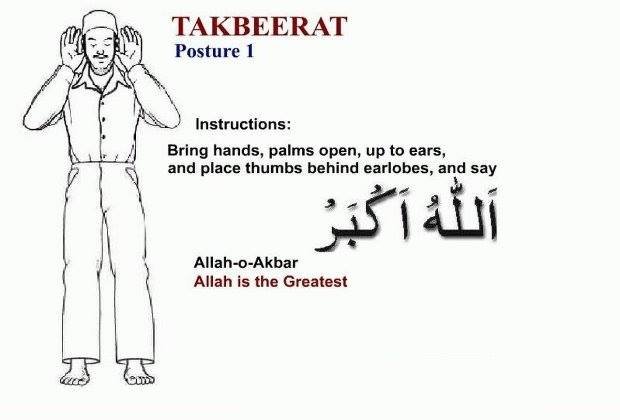
    Then he (sallallaahu ‘alaihi wa sallam) would commence the prayer by saying:

    Allahu akbar
    Translation: ”Allaah is the Greatest”

    He(sallallaahu ‘alaihi wa sallam) ordered “the man who prayed badly” to do likewise as has been mentioned, and he said to him: Verily, the prayer of a person is not complete until he has made an ablution which has included the necessary parts of the body and has then said: ‘Allaahu Akbar’.

    He (sallallaahu ‘alaihi wa sallam) would also used to say: The key to the prayer is purification, it is entered by takbeer and exited by tasleem.

    Also, “he (Peace be upon him) used to raise his voice for the takbeer such that those behind him could hear.”

    But, “when he (sallallaahu ‘alaihi wa sallam) fell ill Abu Bakr used to raise his voice to convey the takbeer of the Messenger (sallallaahu ‘alaihi wa sallam) to the people.”

    He (sallallaahu ‘alaihi wa sallam) would also say: When the Imaam says: Allaahu Akbar, then say: Allaahu Akbar.

    3: Raising the Hands

    He (sallallaahu ‘alaihi wa sallam) would raise his hands sometimes with the takbeer, sometimes after the takbeer, and sometimes before it.
    “He (sallallaahu ‘alaihi wa sallam) would raise them with fingers apart [not spaced out, nor together]”, and “he(Peace be upon him) would put them level with his shoulders”, although occasionally, “he (Peace be upon him) would raise them until they were level with [the tops of] his ears.”

    May Allah make us steadfast in offering our salah and accept it from us, ameen


  • The Prayer of a Sick Person in a Sitting Position

    Learn how to perform SALAH according to SUNNAH [A step-by-step guide]

    The Prayer of a Sick Person in a Sitting Position

    ‘Imran ibn Husain (radiallaahu ‘anhu) said, “I was suffering from haemorrhoids (piles), so I asked the Messenger of Allaah (sallallaahu ‘alaihi wa sallam) and he said, Pray standing; if you are not able, then sitting down; if you are not able to do so, then pray lying down”

    ‘Imraan ibn Husain also said, “I asked him (sallallaahu ‘alaihi wa sallam) about the prayer of a man while sitting, so he said: He who prays standing, that is better; he who prays sitting, his reward is half that of the former. He who prays lying down (and in another narration: reclining), has half the reward of the one who sits.

    This applies to the sick person, for Anas (radiallaahu ‘anhu) said, “The Messenger of Allaah (sallallaahu ‘alaihi wa sallam) came out to the people while they were praying sitting due to illness, so he said: Verily, the prayer of one who sits is (worth) half of the prayer of the one who stands.

    Once “he (sallallaahu ‘alaihi wa sallam) visited a sick person and saw him praying (leaning) on a pillow, so he took it and cast it aside. So the man took a stick to pray (leaning) on it, but he took it and cast it aside and said: Pray on the ground if you can, but otherwise make movements with your head, making your sujood lower than your rukoo.”

    Sitting and Standing in the Night Prayer (Tahajjud):

    He (sallallaahu ‘alaihi wa sallam), used to pray long through the night standing, and long through the night sitting, and if he recited standing, he would bow standing, and if he recited sitting, he would bow sitting.”

    Sometimes, “He would pray sitting, so he would recite sitting until about thirty or forty verses of his recitation wre left; he would then stand up to recite these standing and then bow and prostrate, and he would do likewise in the second raka’ah.”

    In fact, “he (sallallaahu ‘alaihi wa sallam) prayed as-subhah sitting down towards the end of his life when he had grown old, and that was a year before his death.”

    Also “he (sallallaahu ‘alaihi wa sallam) would sit cross-legged.”

    Prohibition of Prayer Facing the Grave:

    He (sallallaahu ‘alaihi wa sallam) used to forbid prayer facing the grave, saying: Do not pray towards the graves, and do not sit on them.